




Letzte Woche stiegen die großen Softwarebörsen und konnten damit ihre Verluste aus dem "SaaSpocalypse"-Ausverkauf Anfang dieses Jahres mehr als auslöschen . Es scheint endlich, als hätten die Befürchtungen, dass traditionelle Software durch vibe-codierte Alternativen ersetzt wird, nachgelassen. Leider verfehlt diese Debatte über die Lebensfähigkeit von Unternehmen, KI intern zu nutzen, um kritische, B2B Softwareanwendungen zu entwickeln, den größeren Punkt des tatsächlichen Einflusses, den KI auf Software hat – nämlich, dass sie ein neues Zeitalter innovativer, KI-orientierter Softwareanbieter einläutet, die große Märkte angreifen.
Spulen wir zurück zum letzten Jahr, als die aktuelle Debatte in der Tech-Branche war, ob das Software-"System of Record" tot sei. Microsofts Satya Nadella behauptete bekanntlich, traditionelle SaaS-Apps würden zu dummen Datenbanken degradieren. Es gab Blogbeitrag um Blogbeitrag darüber, wie die neue Chance für Software darin bestand, ein leichteres "Aktionssystem" zu werden, das auf großen, traditionellen Aufzeichnungssystemen wie Customer Relationship Management (CRM), Enterprise Resource Planning (ERP) und Human Capital Management (HCM)-Produkten basieren sollte. Die gängige Meinung war, dass diese riesigen Softwaresysteme zu schwer zu ersetzen sind und in der Welt der KI ohnehin wenig Wert haben würden – daher sollten Start-ups sich einfach darauf konzentrieren, auf der Engagement-Ebene zu bauen.
Wir glauben, dass etwas Nuancierteres und ganz anderes passiert, während die KI-Welle die B2B-Tech-Landschaft überrollt. In vielen Branchen und Arbeitsabläufen sind wir der Meinung, dass jetzt der beste Zeitpunkt seit sehr, sehr langer Zeit ist, um ein robustes, brandneues System der Aufzeichnung zu entwickeln. Hier ist der Grund.
Fehlendes Bindeglied bei der KI-Verbreitung
Es ist kein Geheimnis, dass heute jeder KI einführen möchte. Aber nach unserer Erfahrung ist der Wunsch von Menschen außerhalb des Silicon Valley – Menschen, die in anderen Berufen als der Technologie arbeiten –, KI zu übernehmen, viel stärker, als es die Menschen im Silicon Valley zutrauen. Das gilt sowohl für B2B- als auch für Verbraucheranwendungen, aber unser Fokus liegt hier ausschließlich auf B2B.
Wenn man jedoch tatsächlich mit diesen KI-neugierigen Menschen spricht – sowohl mit "White Collar"-Fachleuten (Buchhalter, Anwälten, Ärzten) als auch "Blue Collar"-Leuten (Auftragnehmer, Logistik, Einzelhändler), stellen wir fest, dass es ein großes Problem gibt, das ihren weitverbreiteten und erfolgreichen Einsatz von KI verhindert, das im Silicon Valley oft wenig diskutiert wird: die Datenintegrität.
Kurz gesagt, Sie können nicht einfach einen KI-Agenten auf Ihre Daten zeigen und erwarten, dass es funktioniert. Um einen Agenten zu haben, der tatsächlich die Arbeit von Menschen erledigen kann, braucht dieser Agent den kritischen Kontext, der aus der Domänenerfahrung (in einem Job, Workflow, Branche usw.) entsteht, der tief in den Datenrepositorien eines Unternehmens verborgen ist. Die Herausforderung besteht darin, dass Geschäftsdaten im Allgemeinen über mehrere Systeme hinweg fragmentiert sind, von denen viele extrem umständlich sind. Deshalb ist es oft schwierig für Harnesses, qualitativ hochwertige Daten aus diesen Systemen zu extrahieren, um einen Agenten nützlich zu machen.
Genau dieses Kontextproblem zwingt die Menschen interessanterweise dazu, ihre Kernsoftwaresysteme zu überdenken, weil sie KI nicht effektiv einsetzen können, wenn Daten in ihrer Software gefangen sind. Um KI zu übernehmen, glauben viele Technologiekäufer, dass sie ein neues System der Aufzeichnung benötigen. Diese Denkweise ist wichtig, weil sie die Erzählung darüber umschreibt, wo neue KI-Unternehmen aufgebaut werden sollten, nämlich um eine Kategorie von Software – also Systeme der Aufzeichnung – zu beziehen, die für neue Start-ups schon lange tabu waren. Seit dem Wechsel von On-Premise- auf Cloud-Software vor Jahren gab es einfach nicht viele überzeugende Gründe für Unternehmen, ihre Register zu wechseln.
Die TAM-Falle
Das Problem, das dies sowohl für Gründer als auch für Investoren in den letzten zehn Jahren verursacht hat, ist, dass viele dieser Märkte (wie ERP, HCM, CRM) Milliarden an Softwareausgaben ausmachen, weshalb sie für neue Start-ups verlockend sind, gezielt anzusprechen. Historisch gesehen wechselt jedoch nur ein winziger Bruchteil dieses ARR jedes Jahr in diesen riesigen Märkten von einem Anbieter zum anderen.
Wenn beispielsweise die Bruttobindung eines Marktes 90 % beträgt, wechselt per Definition nur einer von zehn Käufern pro Jahr den Anbieter, was bedeutet, dass sich der Markt in einem zehnjährigen Ersatzzyklus befindet. Die Implikation ist, dass selbst ein 5-Milliarden-Dollar-Markt zum Beispiel vielleicht nicht so attraktiv ist: Bei 90 % Bruttobindung bedeutet das, dass jedes Jahr nur 500 Millionen Dollar an "Jump Ball"-ARR für neue Anbieter anfallen.
Wenn man außerdem berücksichtigt, wie viele dieser Jump Balls man als Herausforderer tatsächlich sieht (vielleicht 60 %) und gewinnt (vielleicht 33 %), liegt die Wachstumsobergrenze plötzlich bei etwa 100 Millionen Dollar zusätzlicher ARR pro Jahr. Dieses Konzept des Marktumsatzes macht es wirklich schwierig, das Wachstum in großem Maßstab zu begrenzen, egal wie groß der absolute TAM eines bestimmten Marktes erscheinen mag. In diesem Beispiel würde das Geschäft, von dem wir sprechen – nennen wir es Unternehmen A – nur um 20 % bei einer ARR-Skala von 500 Millionen Dollar wachsen (vorausgesetzt, es gibt keinen Churn).
Letztlich kann ein Softwareunternehmen ARR Bruttoumsatz pro Jahr hinzufügen, und daher wird seine Wachstumsrate durch diese Gleichung begrenzt:
Brutto-ARR-Add-Potenzial = TAM x (1 – Brutto-Retention) x % Markt-Deals erzielt x % Gewinnrate
Bewegte Märkte
In der heutigen Welt sehen wir, wie Softwaremärkte, die zuvor durch hohe Bruttoretentionsraten blockiert waren, wieder aufbrechen , da Unternehmen KI einführen wollen, dies aber oft nicht in ihren bestehenden Systemen schaffen können.
Tatsächlich sehen wir sogar, dass einige Märkte das SaaS-Zeitalter komplett überspringen und direkt von On-Prem auf KI umsteigen, weil die Cloud kein ausreichender Grund war, das System of Record zu wechseln... aber KI ist es! Darüber hinaus verringert KI auch die traditionell Associate Kosten für Technologiewechsel, da die Migration von Daten in ein neues System noch nie so einfach war.
Zurück zu unserem obigen Beispiel: Nehmen wir denselben 5-Milliarden-Dollar-Markt, aber jetzt stellen wir uns statt eines Jump Balls pro Jahr vier vor, (d. h. die Marktbindung fällt auf 60 %). Mit derselben Mathematik, aber für Business B:
5 Milliarden $ x 40 % x 60 % x 33 % = 396 Millionen $
Unternehmen B bringt fast 400 Millionen US-Dollar an ARR pro Jahr auf, was bedeutet, dass das Unternehmen um etwa 80 % wächst, mit einer Umfangsgröße von 500 Millionen US-Dollar an ARR, also etwa viermal so schnell wie Unternehmen A in derselben Größe.
Im Battery-Portfolio haben wir dieses Phänomen beobachtet, dass KI-Systeme von Rekord tief verwurzelte etablierte Konzerne sowohl in horizontalen als auch in vertikalen Märkten verdrängen.
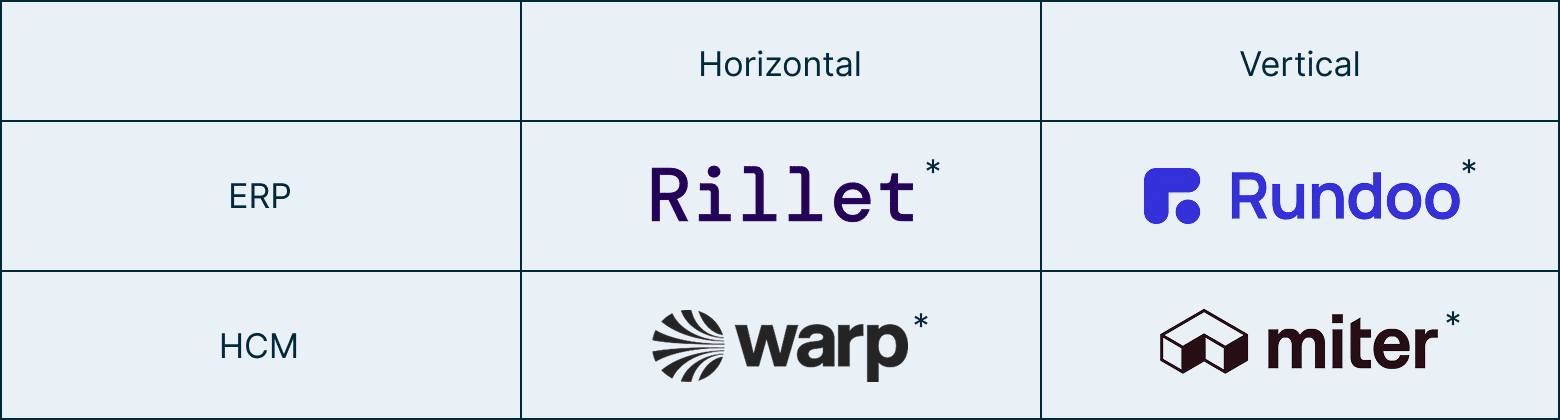
Wie die heutigen Aufzeichnungssysteme aussehen
Wichtig ist, dass Marktfluktuationsraten nicht die einzige Variable sind, die den Markt heute verändert: Die wirkungsvollere Variable ist TAM, das wächst, da Systeme mit Rekord mehr Aufgaben ausführen, die zuvor von Menschen erledigt wurden
Kurz gesagt, der Besitz von Daten ermöglicht ein Aufzeichnungssystem, das das automatisiert, was das "Aktionssystem"-Lager theorisiert: die Ausführung tatsächlicher Aufgaben, um Schlussfolgerungen und/oder Ergebnisse zu monetarisieren. Zum Beispiel könnte ein Agent statt eines Buchhalters die Monatsabgrenzungen durchführen oder Inventar neu bestellen, bevor der Ladenbesitzer überhaupt das Regal überprüft.
Wenn die Eingaben einer Aufgabe, ihre Ausführung und ihr Ergebnis alle in einem System liegen, erfasst dieses System genau das, was KI kontinuierlich lernen muss, je mehr das Produkt verwendet wird. Kurzfristig zeigt sich das als besseres Kontextengineering, damit Agenten mehr Aufgaben korrekt erledigen. Im Laufe der Zeit kann es in Gewichtsverbesserungen umgewandelt werden, um die zugrundeliegenden Modelle selbst zu trainieren, sodass Agenten klüger werden. Dies ermöglicht die Expansion von TAM vom Verkauf von Sitzen zu Tokens und spiegelt die Idee wider, dass der über die Zeit erfasste Wert vom Datenbesitz zur Lieferung von Ergebnissen verlagert wird, was in KI-Systemen nicht ausgeschlossen ist; das erste ermöglicht das zweite.
Mit derselben Mathematik, aber mit der Verdoppelung des TAM von Software zu Arbeit:
10 Milliarden $ x 40 % x 60 % x 33 % = 800 Millionen $
Das Ergebnis ist, dass dieses Unternehmen, Unternehmen C, bei einer ARR-Skala von 1 Milliarde US-Dollar um 80 % wachsen kann – und dabei dieselbe Wachstumsrate aufrechterhalten, die Unternehmen B bei doppeltem Maßstab hatte! Im Vergleich zu Unternehmen, die in verschlossenen TAMs arbeiten, können KI-Systeme von Aufzeichnungen der Schwerkraft wirklich trotzen.
Greenfield-Märkte
Der Vorbehalt ist, dass es in einer Welt mit KI Prozesse und Arbeitsabläufe gibt, die vorher grundsätzlich nicht existierten. Denken Sie daran: Software Engineering in natürlicher Sprache (Cursor/Kognition), Einzelinstruktionsdekonstruktion von unstrukturiertem Text und Daten (Harvey/Legora) oder Analyse der Kundenbindung (Gong*).
Dennoch gilt dieses System-of-Record-Rahmenwerk, aber es gibt eine leichte Anpassung der jährlichen Brutto-ARR-Add-Formel:
Brutto-ARR-Hinzufügungspotenzial = TAM x Marktwachstumsfaktor x % Marktdeals erzielt x % Gewinnrate
Da es in diesen Märkten keine etablierten Unternehmen gibt, die verdrängt werden könnten, existiert das Konzept des Marktumsatzes nicht, sodass die Bruttobindung des Marktes irrelevant ist. Wichtiger ist vielmehr, wie schnell der zugrunde liegende Markt wächst. Dies kann auf mehrere Faktoren zurückzuführen sein. Heutzutage entsteht sie jedoch häufig durch Verbesserungen auf der Modellebene, die es Agenten ermöglichen, längere und komplexere Aufgaben zu erledigen.
Der Vollständigkeit halber betrachten wir Unternehmen D, das in einem vergleichbaren Markt mit einem Wert von 10 Milliarden Dollar operiert. Doch der Markt verdoppelt sich jedes Jahr im Einklang mit den sich erweiternden Zeithorizonten für Aufgabenabschluss:
10 Milliarden $ x 2x x 60 % x 33 % = 4 Milliarden $
In dieser Analyse kann Unternehmen D jährlich 4 Milliarden US-Dollar an neuen brutto ARR hinzufügen. An diesem Punkt kannst du die Wachstumsrate selbst berechnen. Man kann mit Sicherheit sagen, dass es viele Modelle kaputt machen würde!
Abschließend möchten wir behaupten, dass auch diese neuen, KI-nativen Unternehmen tatsächlich Systeme der Aufzeichnung sind. Warum? Erstens sind sie in Nutzer-Workflows eingebettet, was es ihnen ermöglicht, die folgenden wichtigen Daten zu sammeln:
- Cursor/Kognition – Regeldateien, indexierte Einbettungen, erlernte Konventionen, Agenten-Erinnerung an vergangene Entscheidungen.
- Harvey/Legora – firmenspezifische Playbooks und Präzedenzfallbibliotheken, Themengeschichten und Arbeitsergebnisse, Klauselebene-Redline-Muster, Bearbeitungen von Juristen an KI-generierten Entwürfen, agentische Workflow-Vorlagen.
- Gong* – Anrufaufnahmen und Transkripte, Einspruchs- und Talk-Track-Muster, Coaching-Benchmarks, Gesprächsdaten, die mit den Deal-Ergebnissen verknüpft sind.
Daher hat das heute auf dem Markt befindliche KI-System einen strukturellen Vorteil: Es besitzt sowohl den Kontext, den Datenagenten zur Laufzeit benötigen, als auch die Ergebnisdaten, die als Belohnungssignal für das Training dienen, allein weil die Aktionen und deren Ergebnisse im selben System liegen. Diese Kombination verstärkt sich mit der Nutzung.
Workflows erzeugen Aktionstrajektorien, deren Ergebnisse im selben System beobachtbar sind, das das Rohmaterial für das Training ist, das Wettbewerber mit API-Integration nicht erfassen können. Da die KI-App-Schicht dank Open-Weights-Modellen und ausgereifter Eval/RL-Tools zunehmend vertikal in die Modellschicht integriert wird, kann das KI-System diese Daten in Gewichtsverbesserungen für eine bestimmte Aufgabe umwandeln, was eine dauerhafte Differenzierung ermöglicht.
Zuletzt, obwohl KI-Apps heute hauptsächlich auf einer begrenzten Anzahl anderer Systeme aufbauen, werden die KI-Systeme von Record unweigerlich Daten in angrenzendere Softwaresysteme übertragen und abrufen, ähnlich wie traditionelle Systeme of Records. Clay ist bereits ein frühes Beispiel: Das Unternehmen begann hauptsächlich damit, Kontakt- und Unternehmensdaten von einigen wenigen Anreicherungsanbietern zu beziehen. Doch Clay nimmt nun Daten aus dem gesamten GTM-Stack eines Kunden auf – CRM (Salesforce, HubSpot), Vertriebsengagement (Outreach, Salesloft), Produktnutzungs- und Absichtssignale sowie über 100 Drittanbieter-Datenanbieter – und schickt angereicherte Datensätze, Scores und KI-generierte Forschungen zurück in das CRM eines Kunden. Dadurch wird Clay zu einem der wichtigsten Software-Werkzeuge, die GTM-Teams täglich nutzen.
Es gibt keine Absolutheiten
Natürlich gibt es keine absoluten Bedingungen; nicht jede Branche oder jeder Prozess wird ein brandneues, KI-natives System benötigen oder wünschen. Wir denken hier an extrem komplexe Branchen wie zum Beispiel Versicherungen. Andererseits gibt es in einigen Branchen Aufzeichnungssysteme, die leichter nachzubilden sind als andere. Wir sehen großes Potenzial in horizontalen Märkten wie Vertrieb, Ingenieurwesen und Finanzen sowie in vertikalen Branchen wie Fertigung, Logistik und Bauwesen.
Das Fenster ist jetzt
Zusammenfassend glauben wir, dass die Zukunft eher wie die Vergangenheit aussehen könnte, als die aktuelle Tech-Erzählung diesem Technologiezyklus zuschreibt. Die Binsenweisheiten des Geschäfts haben sich nicht geändert: Nachhaltiger Wert entsteht durch erfreuliche Kundenerlebnisse und wettbewerbliche Differenzierung, die mit der Skalierung einhergeht. Die Geschichte der Software würde argumentieren, dass Datenbesitz ein wichtiger Ermöglicher für beide ist. Was sich verändert hat, ist, was Software leisten kann, was dank KI nun die Arbeit selbst ist. Daher werden Systeme der Dokumentation im Zeitalter der KI wie ganz andere Unternehmen aussehen als in der vorherigen Generation – aber das bedeutet nicht, dass sie nicht das Fundament teilen, auf dem jedes großartige Softwareunternehmen aufgebaut wurde.
Die Gelegenheit, ein neues Aufzeichnungssystem aufzubauen, liegt jetzt. Wir befinden uns in einem einzigartigen Zeitpunkt, in dem Kunden KI-neugierig sind, aber größtenteils nicht von ihren bestehenden Softwareanbietern bedient werden. Dieses Zeitfenster wird nicht ewig dauern.
Die hier enthaltenen Informationen basieren ausschließlich auf den Meinungen von Aaron Neil und Michael Brown und nichts sollte als Anlageberatung ausgelegt werden. Dieses Material dient Informationszwecken und ist nicht und darf in keiner Weise als rechtliche, steuerliche oder Anlageberatung oder als Verkaufsangebot oder als Aufforderung zum Kauf eines Anteils an einem von Battery Ventures oder einer anderen Battery Gesellschaft verwalteten Fonds oder Anlagevehikel herangezogen werden.
Diese Informationen umfassen Investment- und Marktaktivitäten, Branchen- oder Sektortrends oder andere allgemeine Wirtschafts- oder Marktbedingungen und dienen zu Bildungszwecken. Die anekdotischen Beispiele sind für ein Publikum von Unternehmer*innen gedacht, die ihre Unternehmen aufbauen möchten, und sind keine Empfehlungen oder Befürwortungen für ein bestimmtes Unternehmen.
*Bezeichnet Battery Portfolio Eine vollständige Liste aller Battery finden Sie unter Bitte klicken Sie hier.









Ein monatlicher Newsletter zum Austausch neuer Ideen, Erkenntnisse und Einführungen, um Unternehmer*innen beim Ausbau ihres Geschäfts zu helfen.